
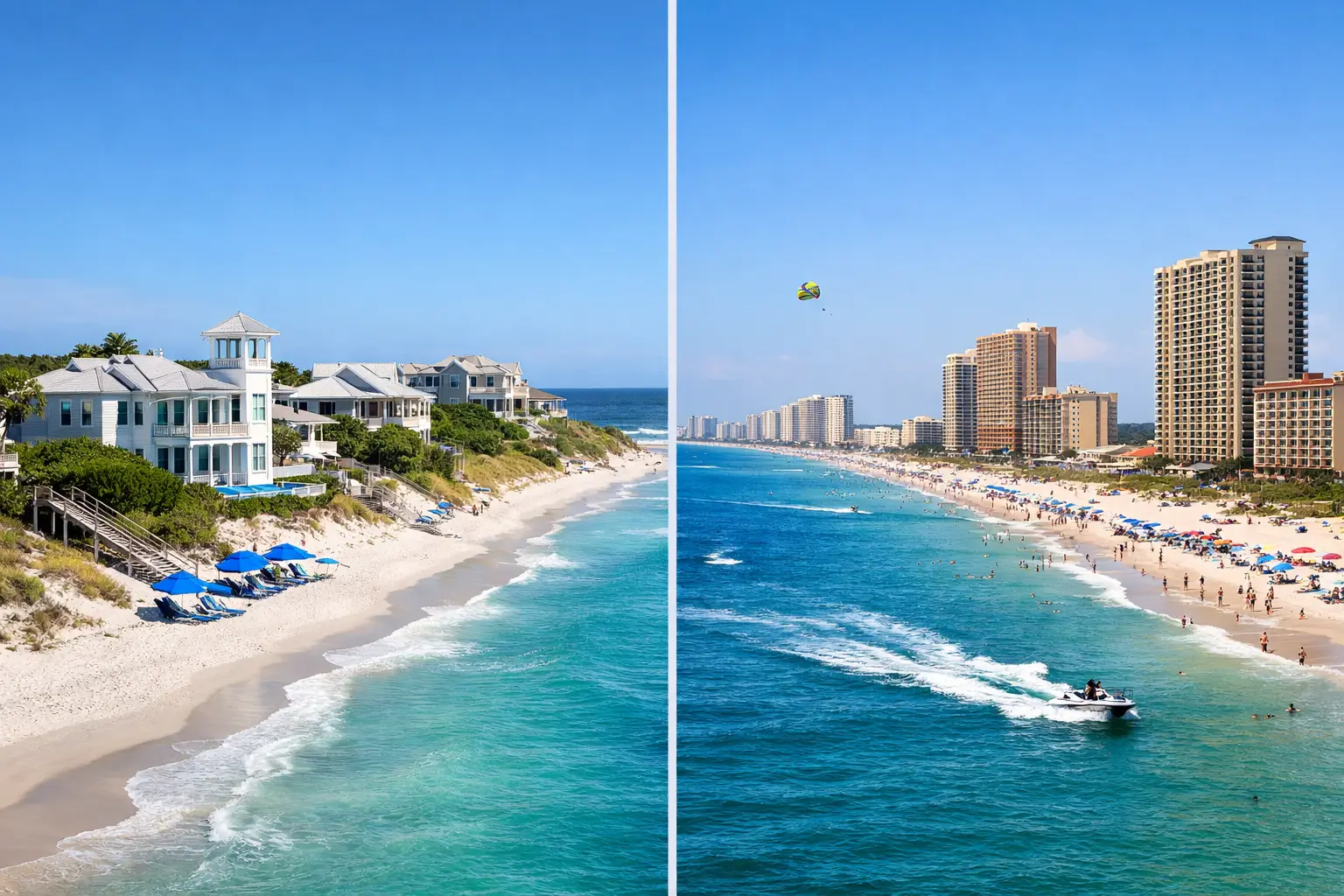
A Gulf-front condo with strong rental history in Panama City Beach can pencil out very differently than a tucked-away 30A cottage with tighter inventory and stronger long-term scarcity. That is the real question behind 30A vs Panama City Beach. This is not simply a beach preference. It is a market selection decision that affects cash flow, appreciation potential, carrying costs, exit strategy, and how often you will actually want to use the property yourself.
For serious buyers, the better market is the one that fits your objectives with the least friction. Some clients want a polished second-home experience with architectural consistency, walkability, and brand-level cachet. Others want scale, stronger tourism volume, and a more direct path to vacation rental performance. Both markets can be compelling. They just reward different strategies.
30A vs Panama City Beach: Two Very Different Coastal Plays
Although these markets sit along the same broader Emerald Coast, they operate on different economics. 30A is a corridor of distinct communities in South Walton, with places like Rosemary Beach, Alys Beach, Seagrove, WaterColor, Grayton Beach, and Blue Mountain Beach each carrying their own identity, inventory profile, and pricing behavior. Buyers are often paying for scarcity, planning standards, lifestyle quality, and a more curated coastal environment.
Panama City Beach is broader, busier, and more volume-driven. It offers a wider range of product types, from beachfront high-rise condos to single-family homes and value-oriented investment properties. The buyer pool is large and varied, and that creates a different kind of opportunity. There is often more flexibility on entry price, more inventory to analyze, and more obvious short-term rental demand at scale.
If your priority is exclusivity, design consistency, and long-term prestige, 30A usually leads the conversation. If your priority is rental throughput, broader consumer demand, and more options across price points, Panama City Beach often deserves a close look.
Lifestyle Fit Often Drives the Best Real Estate Decision
A coastal asset is never just an investment line item. Even clients focused on returns still care about how a property feels, who the surrounding market attracts, and whether the ownership experience matches their expectations.
30A tends to attract buyers who value a quieter, more controlled atmosphere. The communities are known for walkability, boutique retail, upscale dining, and a stronger sense of place. Many owners want a home that functions as both a family retreat and a store of value. The appeal is not just the beach itself. It is the overall environment, from architectural standards to bike-friendly streets to the relative insulation from overdevelopment in key pockets.
Panama City Beach delivers a different energy. It is more active, more accessible, and more tourism-oriented. That can be a positive, especially for owners who want easier access to entertainment, a larger set of dining and retail options, and a more straightforward vacation rental audience. Some buyers prefer that visibility and momentum. Others find it less aligned with a premium second-home experience.
Neither preference is wrong. But mismatch creates regret. A buyer who wants privacy and polish may not be happy with a high-traffic rental corridor, even if the numbers look strong. A buyer who expects heavy booking volume may be disappointed by a 30A property that performs better as a long-term appreciation play than a pure income asset.
Pricing, Scarcity, and Entry Strategy
From a capital deployment standpoint, 30A generally demands more upfront. Premium communities command a pricing advantage because supply is limited, development standards are high, and the market has built sustained brand equity. In many segments, that premium is justified by scarcity and resale durability.
That said, high pricing narrows margin for error. If you are buying on 30A, the specific micro-location matters enormously. One street, one block, or one access point can materially affect value. Properties with superior walkability, beach access, or architectural positioning tend to hold demand more consistently than those that are merely near the action.
Panama City Beach usually offers more entry points. Buyers can access the market through beachfront condos, lower-maintenance second homes, and properties that still allow meaningful participation in the coastal market without the same basis as prime 30A product. That flexibility is attractive to investors who want to diversify, test a rental strategy, or preserve capital for future acquisitions.
The trade-off is that broader supply can temper scarcity-driven appreciation. Not every Panama City Beach asset is interchangeable, but buyers need to be more selective about tower quality, HOA strength, rental competitiveness, and surrounding development pressure.
Vacation Rental Performance: Revenue Is Only Half the Story
This is where many comparisons go off track. Gross rental revenue is useful, but it is not enough. Owners need to evaluate occupancy, seasonality, operating costs, management structure, insurance, reserves, HOA obligations, and guest expectations.
Panama City Beach often has an advantage in tourism volume and booking familiarity. Travelers know the market, search for it directly, and often prioritize beachfront access and price efficiency. That can create strong occupancy for well-positioned condos and homes, particularly when the property is easy to market and simple to operate.
30A can also perform well as a vacation rental market, but the strategy is more nuanced. Some properties command impressive rates because of location, design, and the strength of the surrounding community brand. However, not every 30A home is optimized for income, and owners who buy primarily for lifestyle may accept lower yield in exchange for stronger personal use and longer-term appreciation.
This is why sophisticated buyers underwrite the property, not just the ZIP code. A mediocre asset in a premium market can underperform. A well-bought asset in Panama City Beach can exceed expectations if it has the right view corridor, amenity profile, management plan, and cost structure.
Appreciation and Resale Outlook
When evaluating 30A vs Panama City Beach through a resale lens, 30A often carries a stronger prestige premium. Certain communities have become status markets with very limited inventory and deep emotional demand. That combination can support pricing resilience, especially for homes with timeless design and proximity to beach access or town centers.
Panama City Beach can absolutely appreciate as well, particularly in quality segments and for properties that align with current buyer demand. But the appreciation story is often more product-specific and less universally scarcity-driven. Buyers should pay close attention to what can be built nearby, how much competing inventory exists, and whether the asset will still stand out in three to seven years.
For sellers and future resale planning, 30A often rewards best-in-class presentation and rare positioning. Panama City Beach often rewards sharp pricing, strong marketing, and a clear understanding of the buyer pool. Each market can produce a successful exit, but the path is different.
Which Market Fits Your Objective?
If you are buying primarily for family use, legacy ownership, and premium lifestyle quality, 30A usually has the edge. It offers a more curated experience, stronger community differentiation, and in many cases, a better emotional ownership profile. Buyers who care about prestige, walkability, and scarcity tend to see the higher basis as part of the value proposition.
If you are buying for cash flow, lower relative entry cost, or a more volume-oriented rental strategy, Panama City Beach often makes more practical sense. There is more inventory to choose from, clearer short-term rental demand in many segments, and more flexibility for buyers who want performance without paying top-tier 30A pricing.
If you want both lifestyle and income, the answer gets more precise. Then the decision comes down to micro-market selection, property type, restrictions, management assumptions, and how much personal use you plan to take. This is where broker-level analysis matters. A polished coastal market can hide weak economics, and a busier market can still produce excellent long-term results when the asset is selected correctly.
The smartest buyers do not ask which market is better in the abstract. They ask which market best supports their capital, timeline, use case, and exit plan. That is a more disciplined way to buy coastal real estate, and it usually leads to better outcomes.
If you are weighing 30A against Panama City Beach, treat the choice less like a vacation preference and more like portfolio positioning. The right property should feel right when you arrive and still make sense when you review the numbers six months later.