
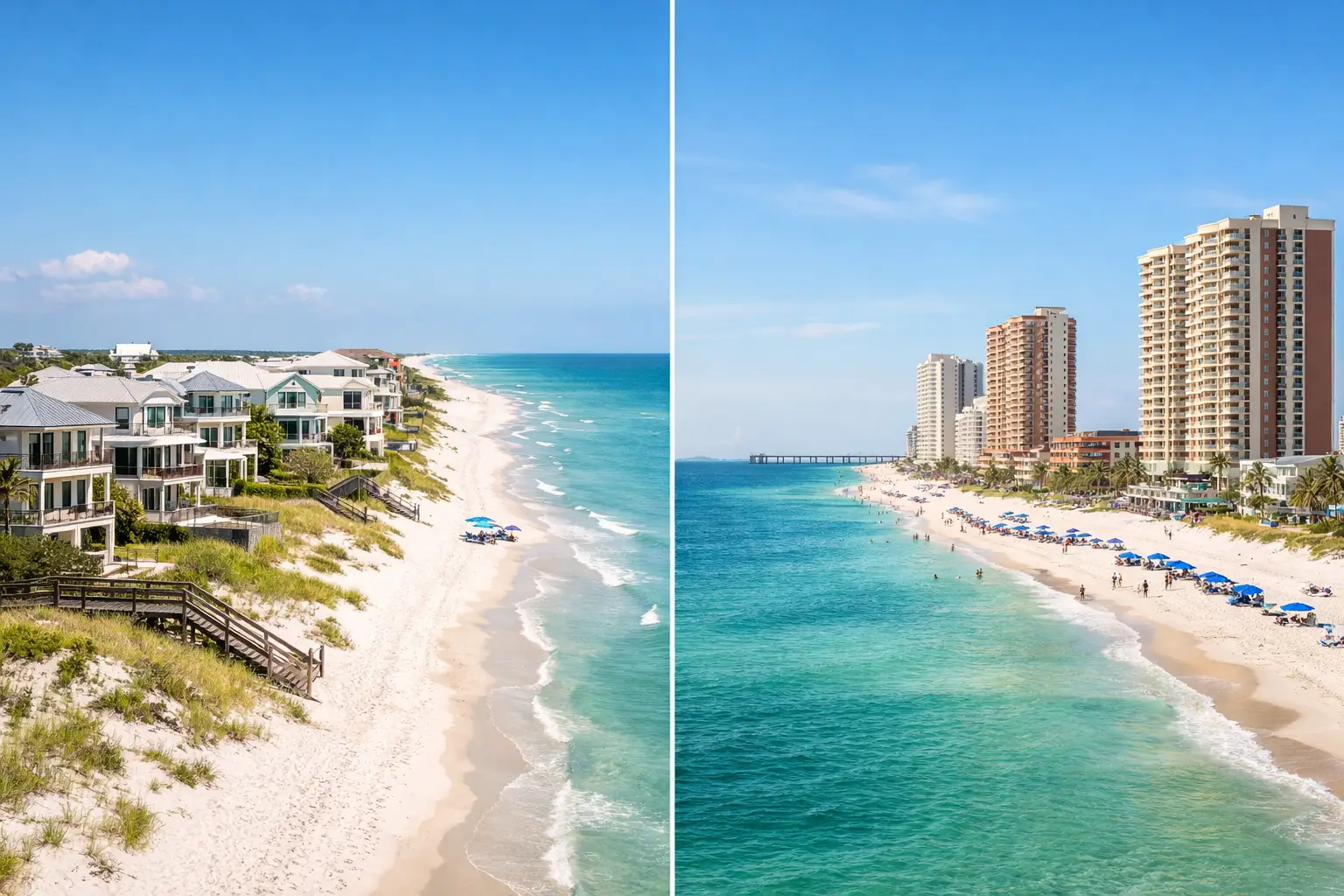
A gulf-front condo that cash flows well is not the same asset as a legacy home in Rosemary Beach. That is the real starting point in any 30A vs Panama City Beach real estate conversation. Buyers often compare these markets as if they are interchangeable beach destinations, but they perform differently, attract different demand, and reward different ownership strategies.
For serious buyers, sellers, and investors, the better question is not which market is better in the abstract. It is which market fits your capital, risk tolerance, hold period, and intended use. Along this stretch of the Emerald Coast, lifestyle and investment logic are closely tied, but they are not identical.
30A vs Panama City Beach real estate: the core difference
30A is generally a scarcity-driven market. It is defined by tighter inventory, stronger architectural controls in many communities, and a brand identity built around exclusivity, design, and a more curated coastal lifestyle. Buyers here are often paying a premium for location quality, neighborhood prestige, and long-term desirability as much as for square footage.
Panama City Beach is broader, more varied, and often more transactional. It offers a wider range of entry points, from high-rise beachfront condos to single-family homes and income-oriented properties. In many cases, buyers in Panama City Beach are more focused on usable yield, flexibility, and value relative to price than on the social cachet that can come with a 30A address.
That does not make one superior to the other. It means each market has a different economic profile.
Price point and entry strategy
If acquisition budget is driving the decision, Panama City Beach usually offers more options. Buyers can often access gulf-view or gulf-front ownership at a lower basis than they can in many 30A submarkets. That matters for investors trying to preserve room for furnishing, renovation, carrying costs, and reserves.
On 30A, pricing tends to reflect constrained supply and sustained prestige. Communities such as Seaside, WaterColor, Alys Beach, and Rosemary Beach are not simply beach towns. They are branded micro-markets with distinct buyer pools and high barriers to entry. Even outside the most elite enclaves, values on 30A are often supported by limited land, strict development patterns, and a buyer base that is less price-sensitive.
The trade-off is straightforward. Panama City Beach can provide a more accessible entry point and a broader menu of asset types. 30A often requires more capital upfront, but many buyers accept that because they are pursuing a higher-quality location profile and, in some cases, stronger long-term insulation from oversupply.
Rental income potential is not the same thing as value stability
This is where many coastal buyers make a costly mistake. They focus too heavily on gross rental projections without asking what kind of asset they are buying underneath the revenue.
Panama City Beach has long been attractive to vacation rental investors because it can produce compelling short-term income relative to acquisition cost. High-rise condos near the beach, especially units with strong views, amenities, and established rental demand, can make sense for buyers who prioritize occupancy and revenue efficiency. For an investor underwriting cash flow, that can be a meaningful advantage.
30A can also generate strong rental income, particularly in walkable, high-demand communities with beach access, strong design appeal, and family-oriented demand. But the math often looks different. The initial purchase price is typically higher, so cap rate expectations may compress even when gross revenue is impressive. Owners on 30A are often balancing rental performance with personal use, long-term appreciation, and prestige ownership.
In other words, Panama City Beach may look stronger on a yield basis in some segments, while 30A may look stronger on a wealth-preservation and appreciation basis. The right answer depends on whether you are optimizing for current income, long-term equity growth, or a blend of both.
30A vs Panama City Beach real estate for appreciation
Appreciation is never guaranteed, especially in coastal markets affected by interest rates, insurance costs, and shifting travel patterns. Even so, 30A has historically benefited from the kind of fundamentals that support premium pricing over time. Scarcity matters. So does brand strength. So does buyer psychology.
When a market has a limited number of highly desirable homes in recognizable communities, values can hold up differently than in areas with more abundant condo inventory or a larger development pipeline. That is one reason many buyers view 30A as a long-hold asset market rather than a pure income play.
Panama City Beach has appreciation potential as well, but it tends to be more segmented. Product type, location within the market, building quality, HOA structure, and competitive inventory all matter significantly. A well-positioned property can perform very well, but the market requires sharper underwriting because not all assets benefit equally from rising demand.
For investors, the practical point is this: on 30A, market selection often starts with micro-location quality. In Panama City Beach, it often starts with asset selection and basis discipline.
Lifestyle matters because it influences resale demand
A second-home buyer may tell themselves they are making a strictly financial decision, but usage patterns tend to shape satisfaction and resale performance. Buyers who prefer a quieter, design-forward, more walkable coastal environment often gravitate toward 30A. The area is associated with boutique retail, carefully planned communities, strong aesthetics, and a less vertical skyline. That emotional appeal is not just branding. It supports demand from a specific class of buyer willing to pay for experience.
Panama City Beach offers a different kind of convenience and energy. There is more scale, more immediate entertainment, more high-rise product, and in many cases easier access to value. For some buyers, especially those with larger groups, broader rental goals, or a preference for amenity-rich condo ownership, that is a feature rather than a compromise.
Resale value often follows these lifestyle distinctions. A buyer pool looking for exclusivity and curated community design behaves differently from a buyer pool looking for beachfront access at a more efficient price point.
Insurance, fees, and holding costs deserve more attention
Two properties can produce very different net outcomes even when purchase prices appear manageable. Coastal ownership costs have become too material to treat as an afterthought.
On 30A, owners of luxury homes may face substantial insurance premiums, maintenance obligations, and in some communities HOA costs that align with the area’s standards and amenities. In Panama City Beach, condo buyers need to look carefully at association dues, reserve health, special assessment risk, and building-specific maintenance exposure.
This is where disciplined analysis separates a smart acquisition from an expensive lesson. A lower sticker price does not always create the better investment. Likewise, a higher-end 30A property is not automatically overpriced if it carries stronger long-term demand and lower competitive substitution.
Which buyer tends to fit each market?
The buyer who fits 30A best is often pursuing a premium coastal asset with strong lifestyle utility, long-term hold appeal, and a location story that should remain relevant over time. They are usually comfortable with higher basis and lower immediate yield if the property offers quality, scarcity, and enduring resale strength.
The buyer who fits Panama City Beach best is often more open to pursuing revenue efficiency, broader inventory, and selective value opportunities. They may still care deeply about appreciation, but they are typically more willing to compare buildings, analyze rental comps, and target assets where the numbers can work harder from day one.
Many clients are not purely one or the other. They want a property they enjoy personally, but they also want disciplined financial performance. That is where broker-level guidance matters most. The right acquisition is rarely found by looking only at list price or projected gross rents. It comes from understanding the market segment, the ownership costs, the local demand profile, and the exit path.
A sophisticated comparison of 30A vs Panama City Beach real estate should end with one honest conclusion: these are not competing versions of the same investment. They are distinct coastal markets with different strengths, different buyer pools, and different definitions of success. If you treat them that way, your decision gets clearer, and your capital is far more likely to land in the right place.
Whether you are buying for lifestyle, yield, or long-term positioning, the strongest move is the one that matches the asset to your actual objective rather than the one that simply looks good on paper.