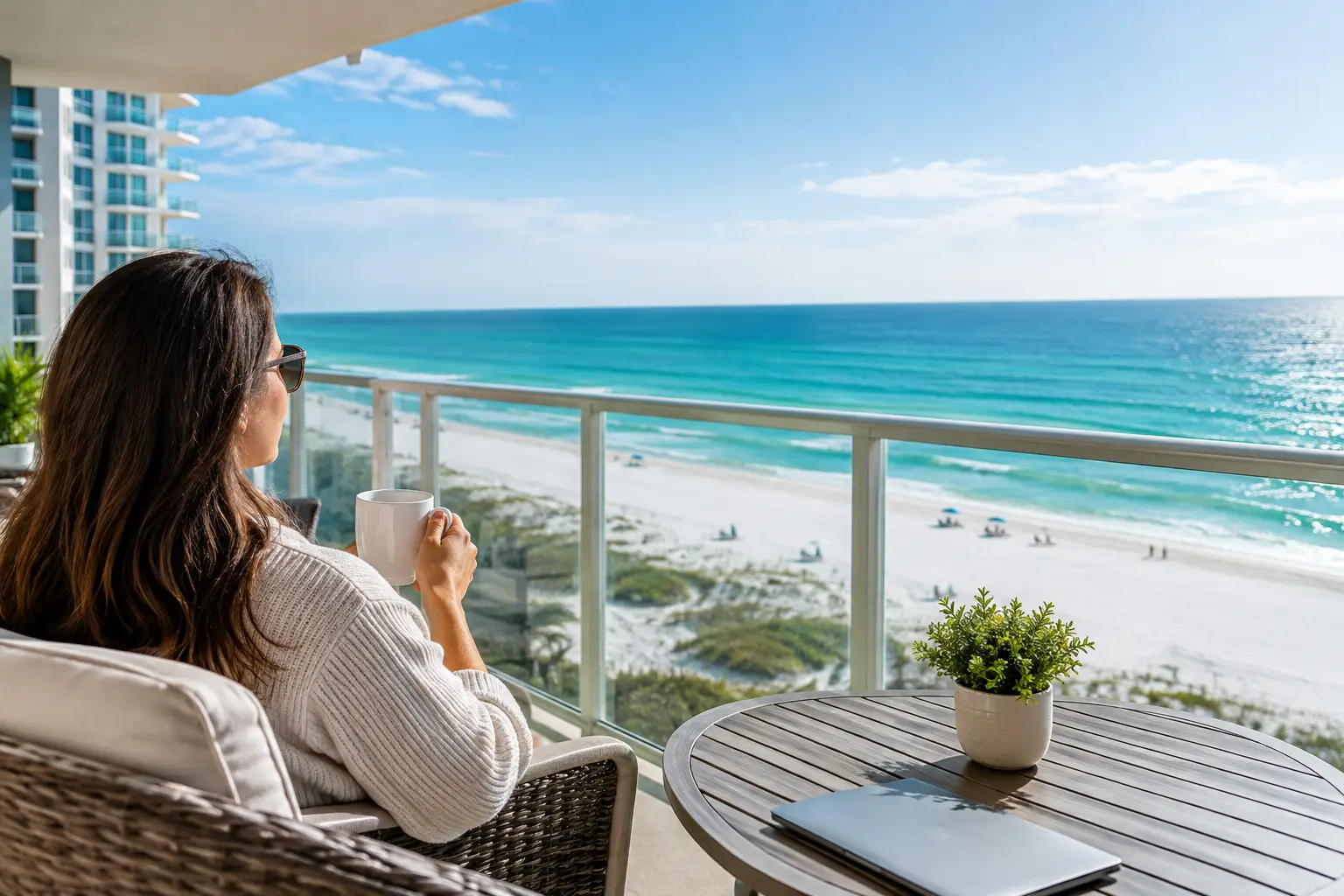
A gulf view can make nearly any Panama City Beach condo feel compelling during a weekend showing. The stronger question is whether the building will still make financial sense after association dues, rental restrictions, insurance costs, and future capital projects enter the picture. This Panama City Beach condo review framework is designed for buyers who want to evaluate the asset behind the view.
Panama City Beach offers a broad condo market, from established gulf-front towers with high rental visibility to lower-density boutique buildings, marina-oriented residences, and newer projects positioned around elevated amenities. That range creates opportunity, but it also means no single metric can determine value. A condo that appears less expensive on a price-per-square-foot basis may carry higher operating costs, weaker rental demand, or a special assessment risk that changes the investment equation.
Panama City Beach Condo Review: Start With the Building
A condo purchase is partly a unit-level decision and partly an investment in a shared operating business. The association controls the exterior, common areas, reserves, insurance structure, rules, and much of the ownership experience. Before focusing on furniture packages or projected rental income, review the building’s operating condition.
Start with the age of the property and the scope of recent capital work. On the coast, roof replacements, concrete restoration, window and door upgrades, waterproofing, elevator modernization, and pool renovations can be material expenses. A well-maintained older tower may be a better acquisition than a newer building with aggressive dues and unproven management. Conversely, a building that has deferred maintenance to preserve low monthly fees can create a costly problem for future owners.
Request and evaluate the association’s budget, reserve balance, recent meeting minutes, insurance information, current assessments, pending litigation, and rental policies. These documents often reveal more than a listing description. Frequent discussion of water intrusion, rising insurance premiums, elevator downtime, delinquent owners, or major repairs deserves careful underwriting.
Monthly association fees should not be judged in isolation. Higher fees can be justified when they include strong insurance coverage, meaningful reserves, professional onsite management, quality amenities, and utilities that support guest demand. Low fees are attractive only when the association is adequately funding the building’s real needs.
Questions that change the investment case
The most useful questions are direct: Is a special assessment planned or being discussed? What work has been completed in the past five years? How much is held in reserves? Is the association financially stable? Are short-term rentals permitted, restricted, or capped? Is the building managed in a way that protects both owner value and guest experience?
For an investor, rental policy is especially consequential. Some condominiums allow short-term rentals with few limitations, while others impose minimum stay requirements, registration procedures, guest rules, or management restrictions. A property marketed as rental-friendly can still have operating rules that reduce flexibility or create friction during peak season. Confirm the policy through association documents rather than relying solely on marketing language.
Location Is More Than Gulf Front
Gulf-front positioning generally supports visibility, rental appeal, and long-term buyer demand, but the specific stretch of beach matters. Access to restaurants, family attractions, shopping, airport routes, marinas, and major roads can influence both occupancy and resale liquidity. Buyers should consider how guests and future purchasers will actually use the location.
West Panama City Beach often appeals to buyers seeking proximity to Pier Park, beach access, and a broader concentration of dining and entertainment. East and central areas can offer a different balance of price point, established towers, and access to local conveniences. Properties near quieter sections of the beach may attract owners prioritizing a more residential experience, although their rental profile can differ from high-traffic resort locations.
The unit’s position within the building also matters. Direct gulf-front units typically command stronger demand than side-facing or limited-view residences, but floor height, balcony depth, bedroom count, parking convenience, and elevator access can significantly affect performance. A two-bedroom unit with bunk capacity may outperform a larger but awkwardly configured residence if it better matches the needs of the dominant vacation-rental guest.
Do not assume every water view delivers the same value. Study the sightline from the living area, primary bedroom, and balcony. Review nearby development sites and zoning conditions where possible. A unit sold on an unobstructed view can lose part of its pricing advantage if future construction changes the experience.
Underwrite Rental Revenue Conservatively
Gross rental projections are useful for comparison, but they are not net income. A disciplined acquisition analysis accounts for management fees, cleaning, maintenance, utilities, association dues, insurance, property taxes, replacement reserves, licensing, and owner-use limitations. The headline revenue number is only the beginning.
Ask for historical rental statements when available and separate actual performance from a management company’s forward-looking estimate. Historical numbers should be evaluated in context. Was the unit professionally photographed? Was it recently renovated? Did the owner block prime dates? Did the building experience construction disruption? Did the property have a strong online reputation and competitive pricing strategy?
Seasonality also matters. Panama City Beach can generate meaningful summer demand, but an investment plan should not depend entirely on a handful of peak weeks. Strong properties tend to capture shoulder-season bookings through location, condition, amenities, and a guest experience that supports favorable reviews. A building with a heated pool, easy beach access, covered parking, and reliable elevators may have a practical advantage over a more visually impressive competitor with recurring operational issues.
Model at least three scenarios: conservative, expected, and high-performing. The conservative case should assume softer occupancy, maintenance surprises, and higher operating costs. If the property only works under the most optimistic rental forecast, it is not being acquired with sufficient margin.
Renovation can improve income, but not every upgrade pays back
Updated kitchens, durable flooring, modern baths, cohesive furnishings, and strong photography can improve booking conversion and average daily rate. Yet over-improving relative to the building and price segment can compress returns. The goal is not to create the most expensive unit in the tower. It is to create a differentiated, durable product that earns its position in the rental market and remains attractive at resale.
Prioritize improvements that guests notice and that reduce operating friction: resilient finishes, quality bedding, functional storage, efficient appliances, smart entry systems, and a layout that accommodates real vacation use. Coastal properties receive heavy traffic, humidity, sand, and salt exposure. Materials should be selected for performance, not just appearance.
Evaluate Liquidity Before You Need It
A condo can produce acceptable cash flow and still be a weaker long-term asset if it has limited resale appeal. Liquidity is shaped by the building’s reputation, association health, financing eligibility, rental demand, unit configuration, and the number of comparable units competing for buyers.
Pay attention to inventory within the same building. If numerous similar units are listed at once, buyers have leverage and sellers may need to compete on price, condition, view, or furnishings. Review recent closed sales, not just active listings, to understand where buyers have actually placed value.
Financing can also affect the buyer pool. Buildings with unresolved insurance issues, litigation, inadequate reserves, or lending restrictions may force more transactions into cash-only territory. That does not automatically make a property unbuyable, but it should affect price, exit strategy, and risk tolerance.
For second-home buyers, resale value is often supported by the same elements that improve ownership enjoyment: manageable access, dependable building operations, a useful floor plan, parking, a compelling view, and an environment that feels cared for. For investors, those same factors often translate into better guest satisfaction and stronger revenue durability.
Match the Property to the Intended Hold Period
The right Panama City Beach condo depends on whether the buyer is pursuing a personal retreat, a primarily income-producing vacation rental, a hybrid-use asset, or a longer-term coastal allocation. A family using the property several prime weeks each year may accept lower net rental income in exchange for personal value. A yield-focused investor may prefer a building with proven rental velocity and efficient operations, even if it lacks the most prestigious address.
The mistake is treating all condo purchases as interchangeable. A decision that is rational for a five-year owner-occupant may be poorly suited to an investor who needs immediate cash flow. Likewise, an attractive rental property may frustrate a second-home buyer who values quiet occupancy and limited transient activity.
The best acquisition is usually the one where unit quality, building health, location, rental strategy, and personal objectives align at a price that leaves room for the unexpected. Before making an offer, give the documents and financial assumptions the same scrutiny you give the gulf view. Coastal real estate rewards buyers who see both the lifestyle and the operating model clearly.